The New Value of Humans in the Age of AI
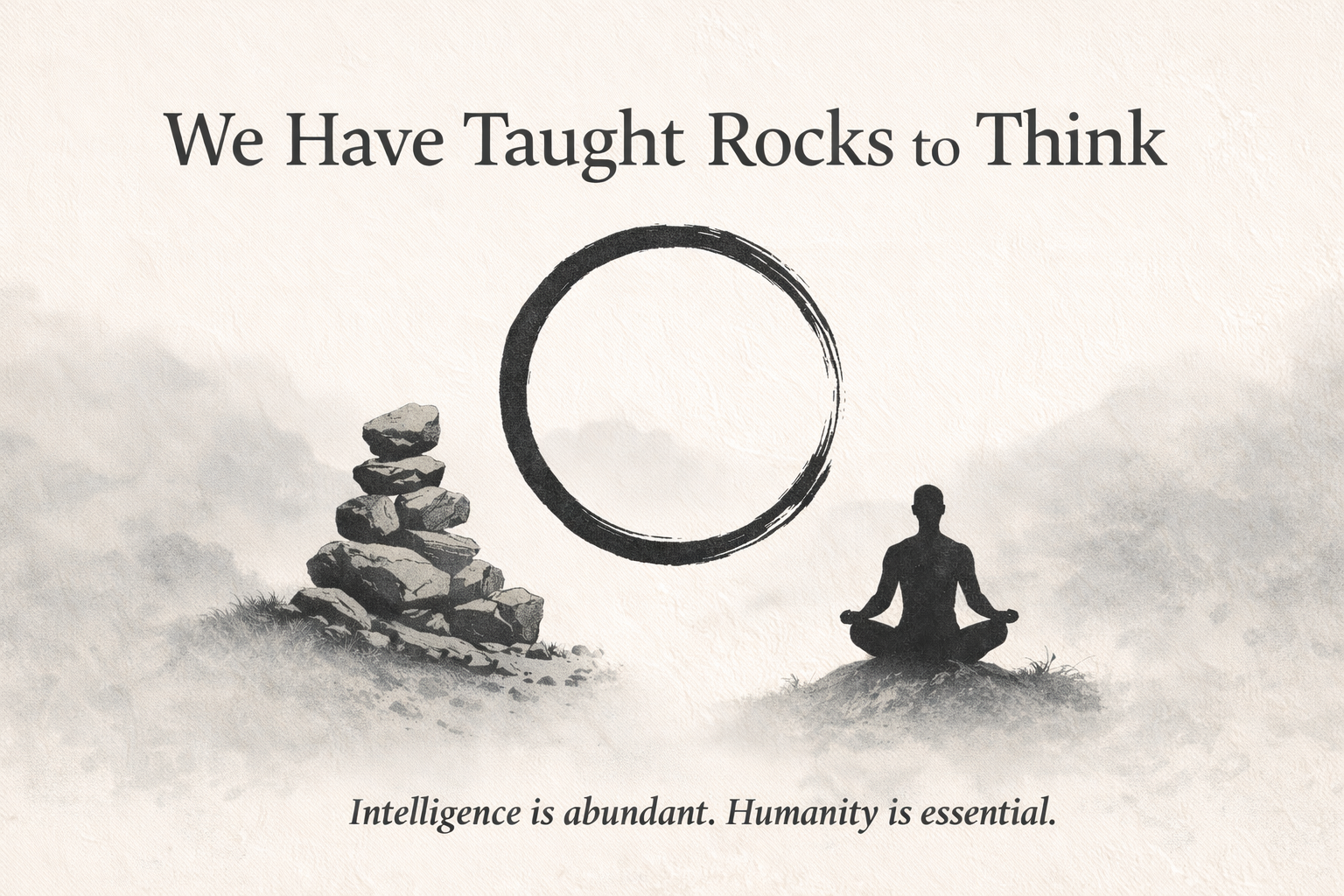
When intelligence becomes abundant, wisdom and character become more valuable.
I run an AI company, so let me begin clearly: I do not think AI is hype.
I believe it is one of the most significant developments in human history.
We have taught rocks to think.
That sentence may sound almost playful at first, but it is worth sitting with. We took sand, metals, electricity, mathematics, and human ingenuity, and arranged them in such a way that matter can now reason, write, plan, predict, recognise patterns, and meaningfully compete with parts of the human mind.
That should humble us.
It should also pull us down from the high horse of human exceptionalism. For a long time, many of us treated intelligence as if it were the defining human trait. School rewarded it. Careers rewarded it. Prestige followed it. If you were quick, articulate, analytically strong, and cognitively useful, you had an edge.
In many cases, that edge could compensate for a great deal of inner disorder.
You could be brilliant, but chaotic. High-performing, but unintegrated. Useful, but not necessarily wise.
AI is beginning to close that loophole.
Intelligence Is Not the Same as Humanity
For much of modern life, intelligence has been treated as the highest form of human value. The smarter you were, the more likely you were to succeed. The faster you could process information, the more valuable you became. The better you could write, calculate, analyse, explain, or solve, the more doors opened.
But intelligence is not the same as humanity.
Intelligence is functional. It helps us perceive, reason, predict, plan, and solve. It is extraordinarily useful. But humanity is something larger. Humanity includes character, courage, compassion, love, grief, meaning, restraint, responsibility, and the ability to endure difficulty without losing yourself.
And between intelligence and humanity sits wisdom.
Wisdom is the capacity to decide what intelligence is for.
That distinction matters more now than ever, because AI is not only changing what we can do. It is repricing what is valuable.
When intelligence becomes cheaper and more widely available, cognitive performance alone stops being enough. The premium begins to shift elsewhere: toward judgment, steadiness, trust, ethics, taste, emotional regulation, courage, and the ability to orient intelligence toward something worthwhile.
This is why I believe AI is forcing us to reassess human value.
Not in a vague or sentimental way, but in a very practical one.
If a machine can now perform many of the tasks that once made us feel impressive, useful, or secure, then we are left with a deeper question:
What remains valuable in us when intelligence is no longer our exclusive advantage?
AI Is Also an Ego Shock
There is a layer to this conversation that many people feel, but do not always say out loud.
AI is not only a technological shock. It is an ego shock.
For a long time, many people built their identity around being “the smart one.” The one who could think faster, write better, understand complexity, solve problems quickly, and make sense of what others could not.
Schools and workplaces rewarded that identity heavily. So heavily, in fact, that being intelligent could allow people to avoid other forms of development. You could be emotionally reactive, relationally difficult, inwardly fragmented, or disconnected from yourself, and still be rewarded because your cognitive output was strong.
But as AI becomes better at cognitive output, that old advantage becomes less secure.
That is uncomfortable.
It is uncomfortable not only because people worry about jobs, although that concern is real. It is uncomfortable because AI now touches something more intimate: identity.
It can do parts of what many people unconsciously built their sense of self around.
That can feel threatening. But it can also be clarifying.
Because it pushes the question back onto us:
If being smart is no longer enough, who are you? What do you stand on?
What in you remains valuable when cognition is no longer your only edge?
These are not small questions. But they are becoming unavoidable.
What Should Young People Do Now?
I have the honour of sometimes being invited back to my old high school to speak to students who are about to graduate. They ask about my path, about technology, about business, and increasingly about AI.
One of the biggest questions now is always some version of this:
What should I do in the age of AI? What should I study? What should I aim for?
I am very glad they ask, because I think these are some of the most important questions a young person can raise today.
My answer is not to ignore technical skill. Quite the opposite.
Learn how systems work. Learn technology. Learn history, incentives, psychology, philosophy, business, and the bigger picture. Build real foundations. Learn how to think clearly. Learn how to spot nonsense. Learn how the world actually functions beneath the surface.
But do not build your identity around technical skill alone.
That is the key point.
Become well-read, yes. But also become well-rounded. Learn attention. Learn relationships. Learn steadiness. Learn how to carry responsibility. Learn how to sit with discomfort. Learn how to use powerful tools without becoming inwardly weak.
And above all, learn that life comes from you, not at you.
That may be one of the most important lessons of all.
If you do not develop an inner centre, the world will constantly tell you what matters, what to chase, what to fear, and who to become. AI will only intensify that. It will amplify confusion just as easily as it amplifies capability.
So if I were speaking to a young person today, I would say this:
Yes, learn the tools. Yes, understand the systems. Yes, become capable.
But spend at least as much effort becoming the kind of person who can use those tools wisely.
Because in a world where intelligence becomes more abundant, who you are matters more, not less.
Education Needs a Deeper Question
This is also why I think education needs to be challenged much more strongly than it currently is.
Too much of it still appears to be built around producing compliant intelligence: information retention, standardised output, clean performance, and the ability to reproduce acceptable answers on demand.
But if machines can increasingly do more of what schools reward, then schools have to ask a deeper question:
What is education actually for?
Surely it cannot only be about producing efficient cognition.
It has to be about helping human beings become more complete.
That does not mean rigour no longer matters. It does. People should still learn mathematics, science, history, writing, systems thinking, and philosophy. They should still build discipline, depth, and intellectual seriousness.
But rigour aimed only at output is no longer enough.
And, of course, it never really was.
The great failure of education in the AI age would be to keep training young people for tasks silicon is increasingly good at, while neglecting the human capacities that are becoming more valuable by the day.
Textbooks often call these capacities “soft skills,” but I think that phrase badly understates what is at stake.
There is nothing soft about integrity.
Nothing soft about emotional regulation.
Nothing soft about courage, self-awareness, restraint, or the ability to understand where your pain comes from without exporting your wounds onto everyone around you.
These may turn out to be some of the hardest and most valuable capacities we have.
Inner Work Is Not a Luxury
This is not abstract for me.
I have had the privilege of receiving executive education, business training, frameworks, mentoring, and structured learning. Much of it was useful. Some of it was excellent.
But if I am honest, what made an even greater difference was inner work.
Mindfulness. Reflection. Personal integration.
That work was harder than most training. More painful too. But also more transformative.
It taught me to notice reactivity, ego, compulsion, distraction, and the subtle ways the mind avoids discomfort. It taught me to separate what is in my control from what is not. It taught me to respond rather than flinch, and to hold myself to principle rather than mood.
I have come to understand that these things are not decorative add-ons to “real” leadership.
They are part of what makes real leadership possible.
As intelligence becomes abundant, attention becomes precious. And AI amplifies the quality of the mind that is using it.
A scattered person becomes more scattered.
An insecure person becomes more performative.
An unethical person becomes more dangerous.
But a grounded person becomes more capable.
This is one of the deepest things I believe about the AI age: powerful tools do not remove the need for inner development. They increase it.
Being Mentally Busy Is Not the Same as Being Present
There is an irony here that I felt personally.
I recently missed one of those speaking sessions at my old school because of a scheduling error. And that error happened, at least in part, because I was too head-heavy in other things. Too mentally occupied. Too absorbed in the next task, the next obligation, the next thing to solve.
I missed one of the invitations that means the most to me.
That stung.
Not because it was dramatic, but because it was instructive.
It reminded me that even while speaking and writing about humanity, it is still possible to neglect one’s own. Even while thinking about integration, it is still possible to become overly cognitive, overly task-bound, overly “productive” in the narrow sense.
It was a useful lesson.
Being mentally busy is not the same as being present.
And in the age of AI, that distinction matters even more.
The New Competitive Advantage
All of this may sound philosophical, but it is also deeply practical.
As AI lowers the cost of analysis, synthesis, and content generation, the real competitive advantage shifts. Not away from intelligence entirely, but beyond it.
Toward judgment.
Toward trust.
Toward leadership.
Toward the ability to coordinate people and tools around a meaningful goal.
Toward ethics.
Toward taste.
Toward emotional steadiness.
Toward the ability to decide what is worth building, what is not, and why.
The companies that win will not simply be the ones with access to intelligence. More and more people will have that. The companies that win will be the ones that can direct intelligence well without losing their humanity in the process.
That is not only a technical challenge.
It is a leadership challenge.
And it is also a cultural challenge.
Because when intelligence becomes easier to access, the quality of the people and cultures wielding it matters more.
AI as a Human Invitation
I do not see AI only as a business revolution, even though it certainly is that.
I also see it as a human invitation.
An invitation to stop over-identifying with intelligence alone.
An invitation to develop character, depth, steadiness, and wisdom.
An invitation to become less performative and more real.
An invitation to become the kind of person who can handle power without losing the plot.
There is a warning in this moment, of course. If your identity is built entirely on being cognitively useful, AI will feel threatening. But there is also an opportunity.
You do not need to compete with machines at being machine-like.
You can become more fully human.
More integrated. More ethical. More aware. More grounded. More capable of using immense power without becoming shallow.
That, to me, is one of the great opportunities hidden inside the AI revolution.
I am optimistic about AI. Deeply so.
But my optimism does not come from the fantasy that machines will solve the human condition. It comes from the possibility that their arrival may force us to face it more honestly.
We have taught rocks to think.
Now the harder question arrives.
What kind of beings will we be in response?
The question is no longer only what machines can do.
It is what humans must become.
